01 / 04
01 / 04
01 / 04
01 / 04
Updated · October 27, 2026
To estimate what a property could sell for, start with recent sales of homes that buyers would consider alternatives. This guide shows you how to find that evidence in Bidicua, screen the comparisons and turn them into a working price range for an asking price, a purchase offer or an auction bid limit.
Use this method for preliminary research. A professional appraisal, inspection and title review address the property-specific questions before you commit money.
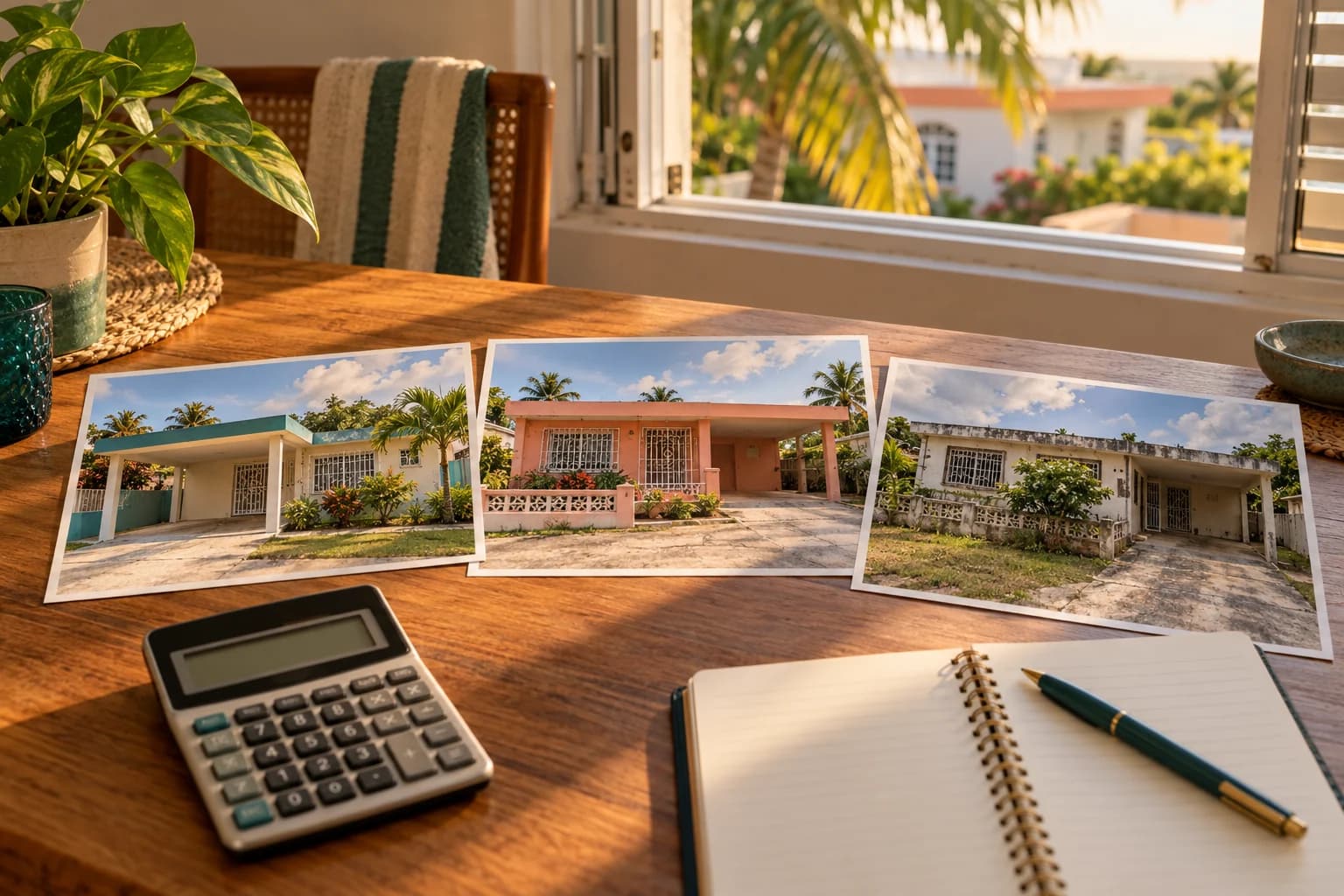
A recorded sale price is evidence of a past transaction. An asking price is the seller's current proposal. An auction minimum is the amount required to open bidding in a particular round. Each answers a different question.
A CRIM assessment is a tax-related value with its own basis and date. A Bidicua estimate or comparable-sales median summarizes available evidence. None of these figures alone establishes what your particular home would sell for today.
First define your target: today's value in its present condition, or a possible resale value after specified repairs. Keep those two scenarios separate throughout the comparison.
Write down the municipality, barrio, urbanization or condominium, street, house or unit number, property type, interior area, lot area, parking and present condition. Match the catastro and legal property description where available. A similar address or a pin on the map is only a starting point.
For an apartment, confirm the building, tower, floor, view and whether parking is included or separately assessed. Keep residences separate from parking spaces, commercial units, common grounds and timeshare interests. A shared parcel family can contain several kinds of records.
Use the same area basis for every comparison. Interior floor area, an open terrace and land area are different measurements. One square meter is about 10.764 square feet; convert units before calculating a price per square foot. If the interior area cannot be verified, compare total prices and leave that calculation out.
Open the relevant report from Markets. Review its boundary, recorded sales, median, time window and data date. Start with the same building or development, then consider competing communities if the local sample is thin. A report median describes its sample; a large house and a small apartment still need separate comparisons.
Where available, open individual records from the report's property directory or sales map. Plus and Pro provide parcel-level records and sale-history access. Check the unit or house identity, sale date, amount and recorded characteristics. Retained official records can show only the latest transfer or an incomplete history; they are not a complete closing ledger.
Review the Market Analysis section and its stated scope. It may show comparable sales, building or neighborhood context, or a broader market sample when close matches are unavailable. Check the sample count and period before using its median. Pro adds detailed sales evidence, price distributions, trends and price per square foot when supported by the data.
Open Workspace's Analytics and choose Sales Market. Filter by municipality, property type, community, sale type and time window; barrio and urbanization filters depend on a municipality selection. Start with Market sales and the last 6 or 12 months, then inspect Recorded Sales and the Sales Map. Compare auction sales and post-auction or lender resales separately. Open linked listings or records where available to check individual matches.
A Market sales label in public-record data does not by itself verify an arm's-length transaction. Check unusual prices and transaction circumstances before keeping a sale.
Review local sale prices, property records and neighborhood boundaries.

Santa Rosa, Guaynabo

Mata de Plátano, Luquillo

Canóvanas, Canóvanas

Pueblo Viejo, Guaynabo
Aim for three to five well-matched closed sales as a working research set. Begin with recent transactions, ideally within 6 to 12 months. Prefer the same property type, a similar size and condition, and the same building or community when it competes for the same buyers. Some properties will have too little evidence to support a reliable range.
If you find too few matches, widen one dimension at a time: an older period in the same community, or a nearby competing community with similar homes. Record why each extra sale is relevant. A nearby beachfront apartment, a walk-up and a detached house can serve very different markets even inside one municipality.
Set aside gifts, nominal-price or family transfers, land-only sales, partial interests, separately sold parking and bundles whose price cannot be assigned to one home. Check whether a low price reflects distress, an occupied sale, major repairs or an unusual transaction rather than a bargain you can reproduce.
For each retained comparable, keep its source or Bidicua link, date, price, area basis, location, condition, parking, transaction type and the reason it belongs in your set. Mark unknown facts explicitly instead of filling them with guesses.
Hypothetical example only: a 1,500-square-foot apartment and three recent sales in the same building, with similar condition, floor, view and parking. All figures in this example are invented for teaching.
| Sale | Interior Area | Sale Price | Price per Sq. Ft. |
|---|---|---|---|
| A | 1,480 sq. ft. | $296,000 | $200 |
| B | 1,520 sq. ft. | $304,000 | $200 |
| C | 1,500 sq. ft. | $315,000 | $210 |
Calculate each sale's price per square foot by dividing its price by its verified interior area. Here the range is $200 to $210. Applied to 1,500 square feet, that gives a preliminary $300,000 to $315,000 range before accounting for remaining differences.
The median total sale price is $304,000. The median price per square foot is $200, which implies $300,000 for the subject's area. These are different summaries, and neither chooses a final price for you. Check which sales most closely match the apartment and why.
Use price per square foot to cross-check the comparison; the value of additional area depends on the property and local market. If the subject needs substantial work while all three sales were renovated, this range describes a different condition scenario. Rework the comparison before calling it an as-is value.
Compare condition and renovation quality, interior layout, usable lot, parking, floor and view. In Puerto Rico, also investigate flood exposure, access, water storage, backup power, insurance costs and building maintenance. For a condominium, request current dues, special assessments and information about common-area repairs; a fee quoted for one unit may not apply to yours.
Adjust a comparable toward the subject: a superior comparable generally needs a downward adjustment, while an inferior one may need an upward adjustment. Support the amount with paired local sales, a qualified appraiser's analysis or other market evidence. A renovation invoice does not automatically add the same amount to market value.
Avoid a fixed percentage for an ocean view, a generic island-wide appreciation rate or an arbitrary discount for an older sale. Use local evidence for changes over time. If a difference cannot be priced credibly, show a wider range or exclude that sale rather than inventing precision.
For a seller, use the strongest closed-sale evidence to choose an asking-price strategy within a defensible range, then review current competing listings. Asking prices show the alternatives a buyer sees; they do not confirm what those properties will close for. Track response and revisit the evidence as new sales appear.
For a buyer, compare the proposed price with the property's as-is range, inspection findings and expected ownership costs. Keep acquisition costs separate from market value. For a seller, calculate expected net proceeds after loan payoff and selling expenses separately from the asking price.
Begin with the same market-value research, then calculate how much you can pay after property-specific costs and uncertainty. A low auction minimum or a reported average auction discount does not establish your safe bid. Have the title, liens, occupancy and court terms reviewed before assigning a budget to them.
For a resale project, a working bid ceiling is conservative after-repair resale proceeds minus repairs, acquisition costs, holding and financing costs, selling expenses, contingency and your required margin. Account for obligations that your review establishes you must pay. Avoid subtracting a repair allowance twice if your starting value already reflects that repair need.
Hypothetical budget: $300,000 planned resale price, less $30,000 repairs, $10,000 acquisition costs, $10,000 holding and financing, $20,000 selling expenses, $15,000 contingency and $25,000 required margin leaves a $190,000 bid ceiling. Replace these assumed amounts with property-specific quotes and your own required margin. Lower resale proceeds or higher costs reduce the ceiling.
For a home you plan to occupy, replace the resale-profit target with your own total acquisition and ownership budget. Confirm auction payment timing independently; a value estimate does not mean financing will be available by the court's deadline. If a material cost cannot be bounded, keep researching before choosing a bid limit.
Bidicua's retained sales cover a research sample with gaps in Puerto Rico closing activity. Check the source, observation date, coverage and selected period. Missing dates, incomplete characteristics or delayed updates can change the picture. Sales Market excludes transactions below $25,000 from market statistics, so an empty result does not establish that no transfer occurred.
Read an estimate's scope and confidence. A community trend, historical price floor or broad municipality median cannot establish the value of one home. If a report uses an older window to obtain enough sales, account for the age of that evidence rather than treating it as current pricing.
Get a qualified local appraiser involved when the property is unusual, the sample is thin, the unit area is uncertain or the financial decision requires a formal value opinion. A broker can help verify competing listings and transaction context; an inspector and title professional resolve different parts of the purchase research.
Start with the same building or neighborhood, confirm individual property identities and compare recent sales of similar homes. Bidicua community reports provide local context; parcel records and sale history are available on Plus and Pro, and Pro Sales Market lets you refine recorded sales by location, type, period and sale category.
The minimum sets the opening bid for a round. Estimate market value from comparable sales and the property's condition, then calculate a separate bid ceiling using your costs, obligations and uncertainty.
Use asking prices to understand current competition. Anchor your working value range in verified closed sales whenever possible, because an advertised amount does not establish the eventual sale price.
Review older sales in the building and recent sales in competing buildings, documenting differences in condition, amenities and market timing. Widen your range when evidence is weak and seek a local appraisal when the decision warrants it.
Bidicua reports, recorded-sales summaries and estimates support property research. They do not replace a professional appraisal, physical inspection or title review.
Reviewed October 27, 2026. Fannie Mae's guidance explains comparable selection and evidence-based adjustments for its lending context; this article uses those research principles without presenting its rules as Puerto Rico law.
Find the community, review the recorded sales and build a comparison you can explain.